History
The estate was once called Domaine de Lassalle. Mark Kirwan, a merchant from Galway, married into it in the 18th century, one of the Irish "wine geese" who settled in Bordeaux. He enlarged it and gave it his name. In the 1855 classification Kirwan was ranked first among the Third Growths of the Médoc. The same year Camille Godard took over. He was a botanist and the man behind Bordeaux's Parc Bordelais, and he restored the château and designed its grounds.
The Schÿler family started buying Kirwan's harvests by subscription in 1902 and took over the estate in the mid-1920s. Jean-Henri Schÿler, of the seventh generation, began replanting the vineyard in the 1960s. The estate has stayed in the family since.
The vineyard
Kirwan's 37 hectares sit on classic Margaux soils: Pyrenean gravel mixed with layers of clay. Its highest plot, Moulin Robert, is 19 metres above sea level. When Philippe Delfaut arrived from Château Palmer in 2007, he had the soils mapped and found 29 different types, and he now farms each plot to suit its soil. Cabernet grows on the warm gravel, Merlot on the clay, and Merlot and Petit Verdot on terraces of deep gravel.
Kirwan has held HVE level 3 since 2017 and has worked to the ISO 14001 environmental standard since 2013. The soil is ploughed and cover crops grow between the rows. Insecticides, herbicides and the most harmful sprays have been banned for years, and organic methods are used "in accordance with the specific conditions of each vintage". Fifteen people work the vines all year, rising to about 100 at harvest.
Winemaking
The cellar was rebuilt in 2015 to work mostly by gravity, with 37 tulip-shaped concrete vats made in Italy, one for each plot. The grand vin ages 18 to 21 months in French oak, half of it new, and is racked from barrel to barrel by gravity without pumps.
Wines we stock
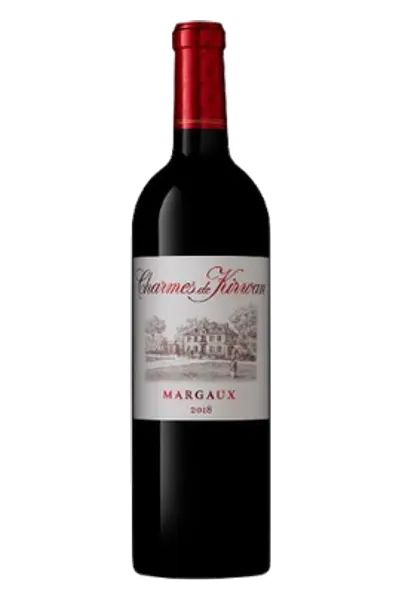
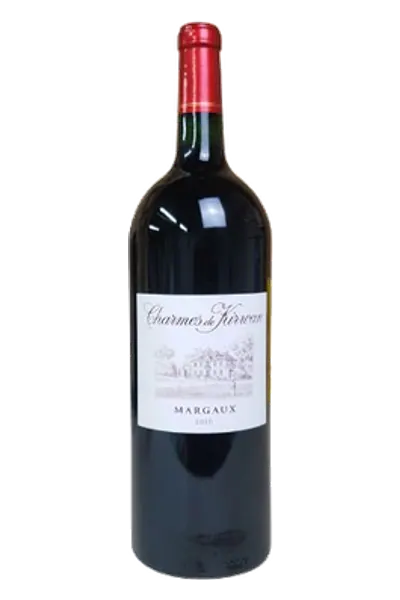
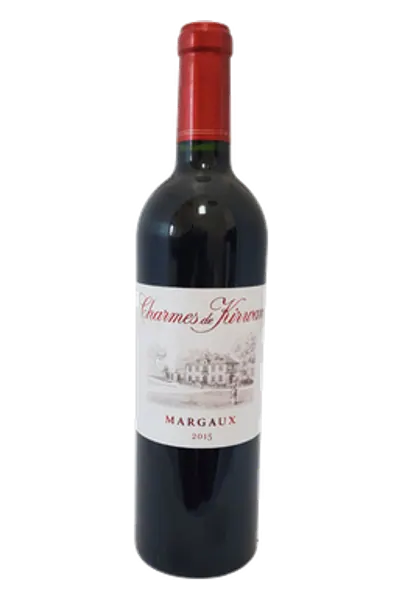
All three are Charmes de Kirwan, the estate's second wine: the 2016 in magnum, the 2018 in magnum and the 2019 in bottle. It's made from the sandy-gravel plots, picked by hand and double sorted. It's fermented in small concrete vats with a gentle extraction and aged 18 months, partly in barrel and partly in concrete. Kirwan describes it as smooth and round, good to drink young.